


Multi-Entity HR Management: One Platform, Clear Separation
Learn how multi-entity HR management separates employee data, permissions and payroll by legal entity while delivering consistent workflows and group reporting.
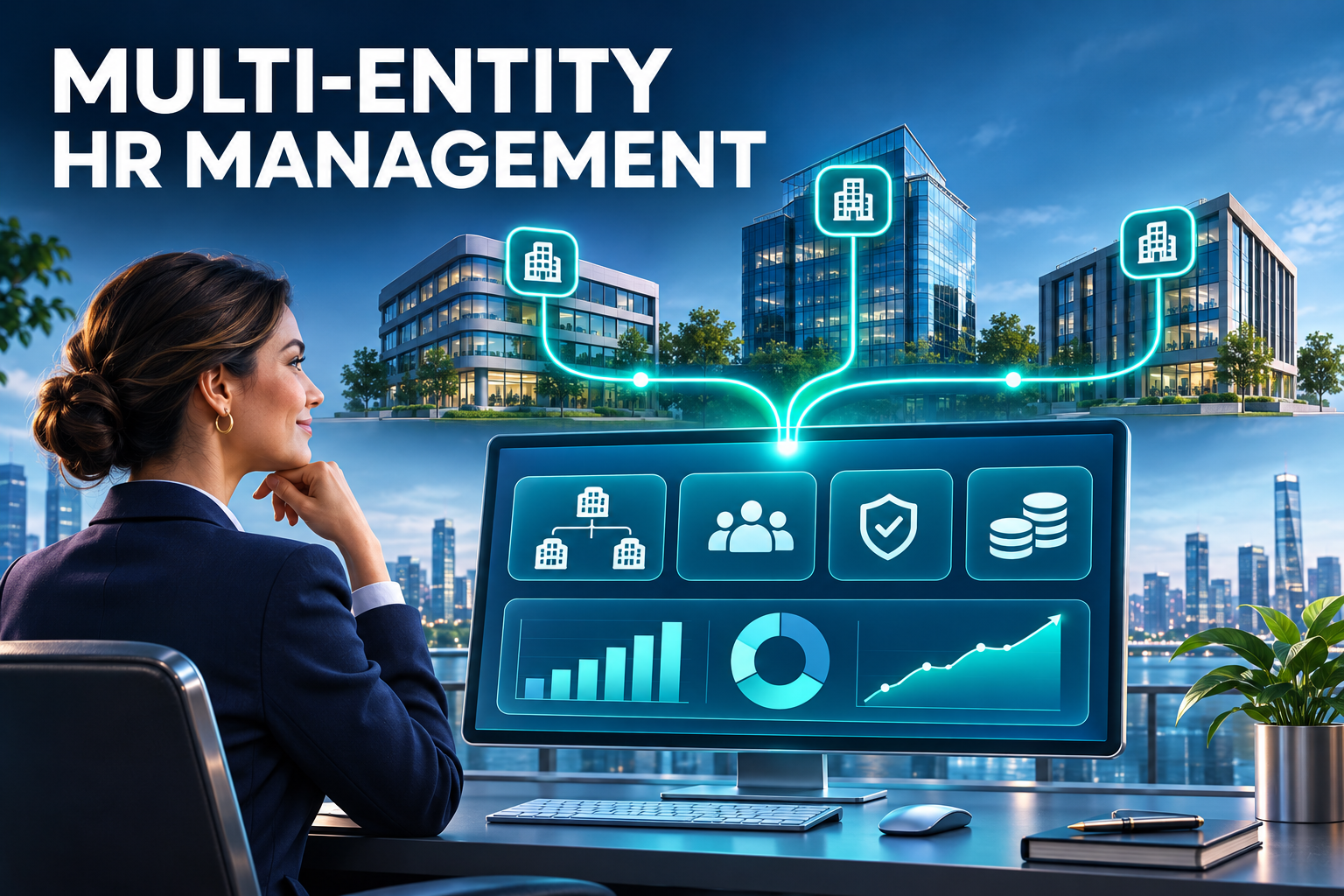
Multi-Entity HR Management: Standardise HR Without Losing Legal-Entity Control
A corporate group may operate several legal entities while relying on one shared HR team. Each entity can have its own employees, payroll, policies, leadership and financial reporting, yet the group still needs consistent data and a consolidated workforce view.
Separate HR systems preserve organisational boundaries but make group reporting slow and inconsistent. A single flat employee database creates the opposite problem: users may see data belonging to entities outside their responsibility.
Multi-entity HR management provides a structured middle ground. It gives each legal entity controlled processes and data ownership while enabling authorised teams to manage shared standards from one platform.
What is multi-entity HR management?
Multi-entity HR management is the administration of workforce data and HR workflows across multiple employing organisations within a shared technology environment.
The platform treats the legal entity as a core dimension of every relevant record, including:
Employee profile
Employment relationship
Position and organisation
Work location
Leave policy
Time and attendance
Payroll group
Compensation
Documents
Approval workflow
Access permission
Reporting
This differs from simply adding a company field to an employee record. Entity context must influence workflows, permissions, integrations and reporting throughout the employee lifecycle.
Multi-entity versus multi-location HR
A multi-location organisation may operate stores, plants or offices under one legal employer. Employees share the same employing entity but work in different places.
A multi-entity group has more than one legal employer. Entities may operate in the same location, use the same HR team or share a brand, but their employment records and payroll processes remain distinct.
Many organisations are both multi-entity and multi-location. Their HR structure may include:
Group
Legal entity
Payroll or employing unit
Location
Department
Position
Employee
A platform designed only for locations may not provide the separation required for different employing entities.
Why separate HR systems become a problem
Workforce data lacks a common definition
One entity may use “active employee” to include long-term leave, while another excludes it. Group headcount reports then show inconsistent results.
Shared services repeat the same work
Central HR teams sign into multiple systems, maintain duplicate templates and combine reports manually.
Internal mobility becomes fragmented
When an employee moves between entities, their prior record may be lost or duplicated. Open expenses, documents, assets and permissions can remain attached to the previous organisation.
Permissions are difficult to govern
A broad HR role may expose salary or employee-relations information across the entire group.
Integrations multiply
Each separate HR platform may require an individual connection with finance, identity management, payroll and analytics systems.
Designing a multi-entity HR architecture
Establish the entity hierarchy
Each legal employer should have a defined record containing:
Legal and operating name
Internal entity code
Country and currency
Payroll groups
Locations
calendars
Responsible HR team
Finance or ERP connection
Effective and closure dates
Stable entity codes are particularly important for integrations and reporting.
Link every worker to the correct employment record
A person and an employment relationship are not always the same record. One individual may leave one group entity and join another, or in some structures hold more than one assignment.
The system should preserve the person’s group history while keeping each employment relationship connected with the correct employer, dates and terms.
Separate global standards from local configuration
Groups often want standard employee fields, security controls and approval principles. Individual entities may still need different leave categories, schedules, benefits and payroll inputs.
A practical configuration model uses three layers:
Group standard
Entity-level configuration
Location or workforce-group exception
This prevents unnecessary duplication without forcing every business unit into identical rules.
Configure entity-specific workflows
A leave request may require one approval in one entity and two approvals in another. An expense above a defined amount may need entity finance approval.
Workflow conditions may include:
Legal entity
Location
Department
Request type
Amount
Employee population
Manager level
Cost centre
The workflow should route transactions to current role owners rather than depending on manually entered email addresses.
Protecting data with entity-aware permissions
Multi-entity security requires more than standard application roles.
A permission should answer three questions:
Which functions can this user perform?
Which employee population can the user access?
Which data categories can the user view or change?
For example:
A group HR director may see consolidated headcount but not every medical document.
An entity HR administrator may manage employees in one legal entity.
A payroll specialist may access selected payroll groups.
A manager may see only assigned employees.
A finance user may receive approved cost data without full employee files.
An employee may access only their own records and requests.
Sensitive data should remain restricted even when a user has broad organisational visibility.
Managing intercompany employee moves
Moving an employee between legal entities is not the same as changing departments.
The workflow may need to address:
End date with the previous employer
Start date with the new employer
New contract and employment documents
Compensation and benefits
Leave balance treatment
Open expenses and advances
Asset return or reassignment
System and physical access
Payroll-group change
Reporting-line update
Historical record retention
The platform should not overwrite the previous employment relationship. It should create a controlled transition while preserving the employee’s group history.
Multi-entity time, attendance and payroll
Time records must carry both worker and employing-entity context. This becomes particularly important when sites host employees from several group companies.
The system should prevent:
Employees entering the wrong payroll population
Attendance posting to an incorrect entity
Overtime approvals reaching the wrong manager
Leave rules being taken from another company
Payroll files mixing legal employers
Accounting entries using the wrong cost centre
Managers viewing employees outside their authorised structure
A shared dashboard can display the readiness of every payroll group while preserving separate calculations and approval routes.
Shared services without central bottlenecks
Centralisation should not require the group HR team to approve every transaction.
Activities suited to shared services
Data and process standards
Platform administration
Group reporting
Security governance
Executive workforce analytics
Shared templates
Talent and succession frameworks
Integration management
Activities suited to entity HR teams
Employee-data maintenance
Local onboarding and offboarding
Leave and attendance exceptions
Document verification
Payroll preparation
Employee requests
Coordination with local managers
Clear ownership allows central teams to govern the process without delaying routine work.
Consolidated workforce analytics
A multi-entity platform should provide both entity-specific and group-wide reporting.
Useful measures include:
Headcount by legal entity
Joiners and leavers
Employee turnover
Open positions
Absence and overtime
Payroll cost
Workforce-budget variance
Missing employee documents
Training and credential status
Internal moves
Organisation and management layers
Shared-service workload
Consolidation must respect access rules. A user may be allowed to see a group total without receiving the employee-level data behind it.
Data definitions should also be standardised. Without common definitions for headcount, active status or turnover, putting reports on one dashboard will not make them comparable.
Integrating different business systems
Group companies may use different payroll, finance or ERP applications. The HR platform should support separate connections and mappings for each entity.
Integration design should define:
System of record for each data element
Entity and employee identifiers
Transfer frequency
Required fields
Error ownership
Reconciliation controls
Failed-record notifications
Change and audit history
A failure affecting one entity should not silently stop data exchange for every company in the group.
What to ask during a software demonstration
Ask the provider to show:
Creation of multiple legal entities
Entity and location hierarchy
Entity-specific leave policies
Separate payroll groups
Population-based access permissions
Restricted access to sensitive documents
Different approval workflows
Intercompany employee transfer
Consolidated group reporting
Entity-specific ERP integration
Audit history
Mobile employee experience
Bulk organisational changes
Data export with entity boundaries
A useful demonstration should follow one employee moving from one entity to another. This scenario exposes limitations that a standard employee-profile demonstration may not reveal.
Frequently asked questions
Can several legal entities use one HR platform?
Yes. The platform should separate employment records, policies, permissions, payroll groups and integrations by entity.
Can group HR see every employee?
Only if authorised. Consolidated reporting and access to detailed employee data should be configured separately.
How should an intercompany transfer be recorded?
The previous employment relationship should be closed and a new relationship created under the new entity. Relevant documents, balances, assets and permissions should follow controlled rules.
Can each entity use a different payroll provider?
Yes. Entity-specific integrations and payroll groups can support different providers while maintaining group-level monitoring.
Is multi-entity HR the same as global HR?
Not necessarily. A group may operate multiple entities in one country. Global HR adds country-specific legal, payroll, language and data-transfer requirements.
Manage every entity separately—and the group as one
HR&Tomorrow enables organisations to configure multiple companies, workplaces, organisational structures and employee populations in one connected platform.
Entity-specific leave, attendance, payroll, document and approval rules remain separated, while authorised group users gain consolidated operational visibility.
Request an HR&Tomorrow demo to see how multi-entity HR management can bring standardisation, security and group-wide visibility to your workforce operations.