
Skills Gap Analysis: A Practical Guide for HR Teams
Learn how to conduct a skills gap analysis, prioritise workforce capability needs and connect learning, internal mobility and hiring with business goals.
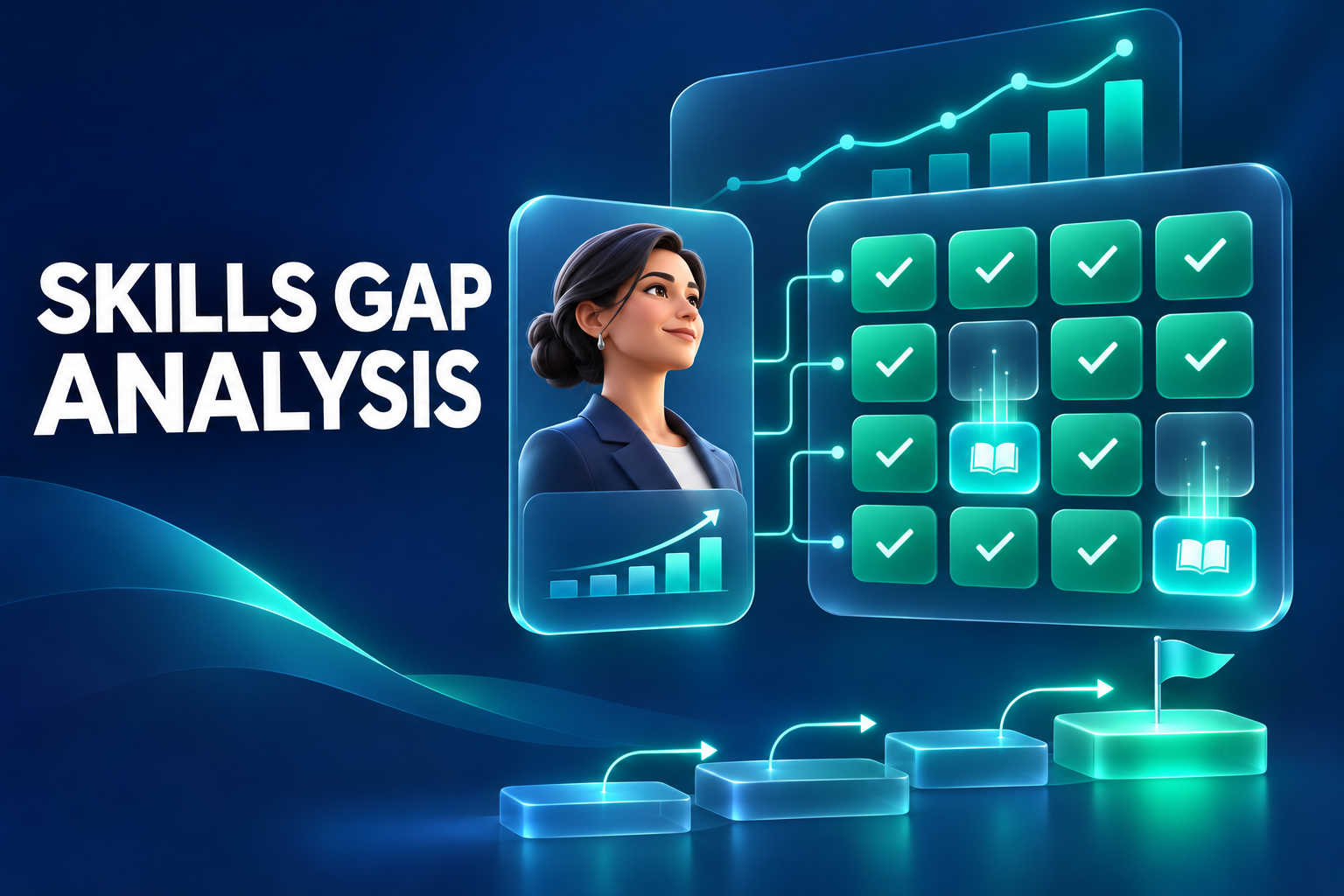
Skills Gap Analysis: How to Identify Workforce Capability Needs
Most organisations can report how many employees they have. Far fewer can confidently explain which capabilities exist, where they are located and whether they will support the next stage of the business strategy.
The problem often becomes visible during change. A new system is introduced, an experienced specialist leaves or a strategic project begins—and leaders discover that a critical capability is either missing or concentrated in one person.
A skills gap analysis compares current workforce capabilities with those required for present and future work. It gives HR a common evidence base for learning, hiring, internal mobility and workforce planning.
What is a skills gap analysis?
A skills gap analysis identifies the difference between the capability level required for a role or business objective and the capability currently available.
The basic relationship is:
Skills gap = Required capability level − Current capability level
If a role requires level four data-analysis capability and the validated current level is two, the employee has a two-level gap.
The numerical difference is only the beginning. HR must also establish:
Why the skill is required
Which outcome depends on it
When the capability will be needed
Whether the requirement is permanent
How many employees need the capability
Whether the gap can be developed internally
Whether work can be redesigned or automated
When external recruitment is necessary
Skill, competency and qualification
These terms should not be treated as interchangeable.
Skill
A skill is the ability to perform a defined activity, such as data modelling, payroll processing, machine operation or speaking a language.
Competency
A competency combines knowledge, skills and observable behaviours. Strategic thinking or customer leadership may contain several skills and behavioural indicators.
Qualification or certification
A qualification can demonstrate that a person completed a programme or met a formal standard. It does not always prove that the capability is current or can be applied successfully in the organisation’s working environment.
A reliable capability profile may therefore combine skills, competencies, certifications and evidence from actual work.
Why conduct a skills gap analysis?
Align learning with business priorities
Training programmes often begin with available courses rather than business requirements.
Gap analysis reverses the sequence. It defines the required outcome first and selects development only when learning is an appropriate response.
Improve hiring decisions
Not every missing skill requires another permanent employee. The organisation may develop existing staff, redesign work, use temporary expertise or automate part of the activity.
Reduce key-person dependency
A capability may appear to exist because one experienced employee possesses it. If nobody else can perform the work, the organisation still has a significant continuity risk.
Support internal mobility
Employees can compare their verified skills with the requirements of available roles and understand what development would improve their eligibility.
Prepare for future work
Future capability requirements may come from automation, new products, changing customer needs, regulation or geographic expansion.
The analysis should therefore cover both current and forward-looking gaps.
At which levels can gaps be analysed?
Individual level
Compare an employee’s current capabilities with their role requirements or desired career destination.
Team level
Examine whether the group collectively has sufficient coverage. Team analysis should identify skills held by only one person.
Role level
Define the capabilities, proficiency levels and evidence required for successful performance in a position.
Organisational level
Assess broader strategic capabilities such as data literacy, digital leadership, customer experience or operational resilience.
Each level serves a different decision. An individual gap may create a development plan, while an organisation-wide gap may require a multi-year workforce strategy.
How to conduct a skills gap analysis
1. Start with a business outcome
Do not begin by asking which courses employees would like to attend.
Begin with a defined objective, such as:
Implementing a new enterprise system
Opening a new location
Reducing production defects
Improving customer retention
Building a leadership pipeline
Introducing automation
Expanding into another market
Creating succession coverage
Capabilities should be derived from the work the organisation needs to perform.
2. Define the required capabilities
Identify the small number of skills and competencies that materially affect the outcome.
For each capability, record:
Name and definition
Observable indicators
Proficiency scale
Required level by role
Whether it is essential or desirable
Evidence accepted for assessment
Effective and review dates
3. Assess current capability
Use evidence appropriate to the skill.
Possible sources include:
Employee self-assessment
Manager assessment
Practical exercises
Tests
Work samples
Performance results
Project history
Multi-rater feedback
Training records
Verified certifications
Previous role experience
Technical skills may require demonstration. Leadership behaviours may require observation across several situations. One assessment method will not be appropriate for every capability.
4. Compare required and available levels
A digital matrix can show:
Requirement met
Minor development gap
Critical gap
Assessment missing
Capability not applicable
Single-person dependency
Evidence expired or outdated
The analysis should retain the assessment date and source. A five-year-old rating should not be treated as current evidence.
5. Prioritise the gaps
A large gap is not automatically the highest priority. Consider:
Impact on business outcomes
Criticality of the role
Number of employees affected
Deadline for capability
Risk created by the gap
Time required to develop it
Availability in the labour market
Cost of different interventions
This prevents HR from investing heavily in visible but low-impact capability areas.
6. Select the right response
Options may include:
Structured learning
Microlearning
Coaching
Mentoring
On-the-job practice
Stretch assignments
Job rotation
Internal mobility
Process redesign
Automation
Contractors or external experts
Permanent recruitment
If the performance problem comes from unclear expectations or inadequate tools, training is unlikely to solve it.
7. Reassess capability
Course completion is an activity metric, not proof that the gap has closed.
Reassessment should examine whether the employee can apply the capability and whether the intended work outcome has improved.
Building a competency matrix
A competency matrix maps employees or roles against required capabilities.
A basic matrix may contain employees in rows, capabilities in columns and current levels in the cells.
A more useful system also stores:
Required level
Current level
Gap
Assessment method
Supporting evidence
Last assessment date
Reviewer
Development action
Review date
The matrix can answer practical workforce questions:
Which teams lack a critical skill?
Which capabilities depend on one person?
Who is ready for a new project?
Which employees could move internally?
Which learning programmes deserve priority?
Which skills require external recruitment?
Which capabilities are becoming obsolete?
Connecting gaps with learning
Learning should be assigned only after the cause and required application have been defined.
A development pathway can include:
Capability gap identified
Appropriate learning or experience assigned
Manager confirms the application opportunity
Employee completes the activity
Capability is reassessed
Work evidence is reviewed
Profile and development plan are updated
This workflow moves learning beyond course attendance.
For example, completing a project-management course may provide foundational knowledge. Demonstrating project planning, stakeholder coordination and risk management in a real assignment provides stronger evidence of capability.
Common mistakes
Creating an oversized skills catalogue
Hundreds of overlapping skill names create administrative work and make the most important gaps difficult to see.
Using self-assessment as the final answer
Self-assessment supports reflection, but confidence and competence are not identical. It should be calibrated with relevant evidence.
Applying one scale without definitions
“Beginner,” “intermediate” and “advanced” must be supported by behavioural or task-based descriptions.
Treating every gap as a training request
Some gaps are better addressed through experience, job design, internal movement or recruitment.
Assessing only current job descriptions
Historical job descriptions cannot reveal capabilities required by a future operating model.
Ignoring adjacent and transferable skills
Employees may possess capabilities from previous roles or personal development that are not visible in their current job title.
Failing to maintain the data
Projects, training, certifications and role changes should update the profile. Otherwise the matrix quickly becomes another obsolete spreadsheet.
Responsible use of skills data
Skills information can affect learning access, career opportunities and workforce decisions. Access should therefore be role-based and assessment criteria transparent.
Employees should be able to:
Review relevant profile information
Understand proficiency definitions
Add evidence where appropriate
Challenge inaccurate records
See agreed development actions
Automated recommendations can help match skills with learning or roles, but they should remain explainable and subject to human review.
Frequently asked questions
How often should a skills gap analysis be conducted?
A comprehensive annual review is a practical baseline. Relevant skills should also be updated after major projects, technology changes, role redesign or strategy changes.
Is skills gap analysis the same as training needs analysis?
No. A skills gap may lead to training, but it may also require experience, internal mobility, recruitment, automation or work redesign.
Should every employee use the same competency framework?
An organisation may have shared core competencies, while technical and role-specific requirements should vary by job family.
Can employees assess their own skills?
Yes. Self-assessment provides useful input, but important decisions should use manager review, testing or work evidence as well.
Does a certification prove proficiency?
Not always. It may demonstrate learning or compliance with a standard, while current workplace application should be assessed separately.
Turn skills data into workforce action
HR&Tomorrow connects role requirements, employee competencies, performance results, learning and certifications in one employee record.
HR teams can identify capability gaps by employee, team and position, then connect the findings with development, internal mobility and recruitment decisions.
Request an HR&Tomorrow demo to see how skills gap analysis can become a measurable and continuously updated workforce process.