


Payroll Software vs Outsourcing: Which Model Is Right?
Compare payroll software and outsourcing across cost, control, expertise, security, scalability and risk to choose the right operating model.
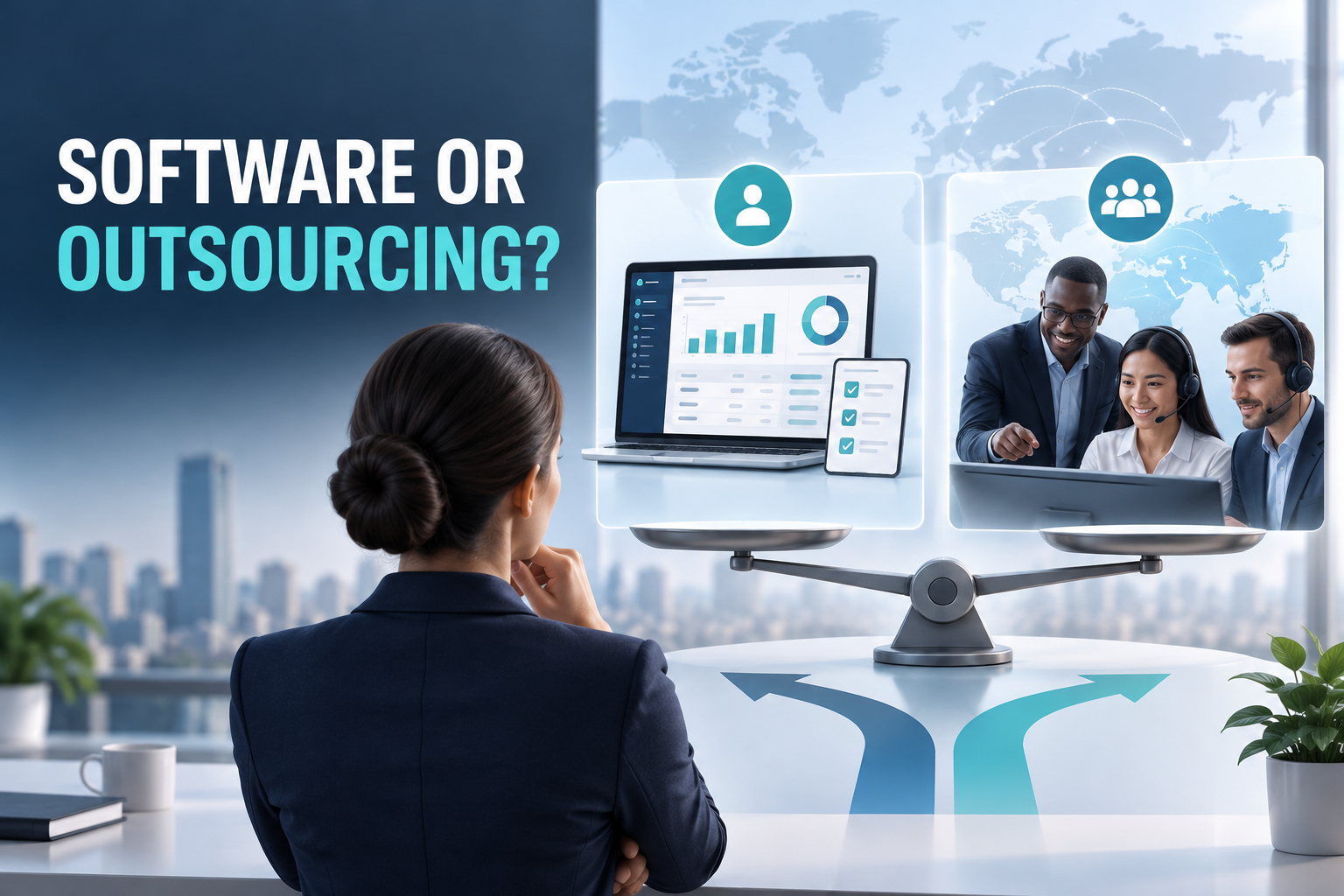
Payroll Software vs Outsourcing: Which Model Is Right for Your Business?
Organisations modernising payroll usually face two options: give the internal team better payroll software or transfer defined activities to a managed payroll provider.
The decision is more complex than comparing a software licence with a service fee. It determines where expertise sits, how responsibilities are divided and how the organisation responds when payroll inputs are late or incorrect.
What is the payroll software model?
In an in-house software model, the employer licenses a payroll platform while its own team remains responsible for operating payroll.
The internal team normally:
Maintains employee data
Collects monthly inputs
Runs calculations
Reviews validation reports
Corrects errors
Approves payroll
Produces payment and accounting files
Manages statutory activities
Answers employee enquiries
The platform provides automation, but payroll knowledge and operational capacity must remain inside the organisation.
What is the outsourcing model?
In an outsourced model, an external provider performs defined payroll tasks.
The provider may process inputs, calculate payroll, prepare validation reports and generate agreed outputs. The employer supplies data, makes policy decisions and approves the final result.
The key difference is therefore the operating responsibility—not the existence of payroll technology. Outsourcing normally uses software as well.
Side-by-side comparison
Decision areaPayroll softwarePayroll outsourcingDaily operationInternal teamProvider teamExpertiseMaintained internallyIncluded in serviceDirect controlHighManaged through approvals and SLAsKey-person riskInternal dependencyProvider resource modelTechnologyLicensed by employerUsually included or integratedScalingMay require more employeesService capacity can expandCost modelLicence plus internal resourcesService fee plus optional itemsRegulatory monitoringInternal responsibilityProvider supports monitoringEmployee supportEmployerEmployer, provider or sharedProcess customisationPotentially extensiveDepends on service design
Comparing total cost
A fair comparison uses total cost of ownership.
Payroll software costs
Include:
Licence fees
Implementation
Data migration
Integrations
Internal payroll salaries
Training
Cover for absence and turnover
Technical support
Security administration
Overtime during payroll close
Error correction
Outsourcing costs
Include:
Per-employee processing fees
Implementation and parallel runs
Entity or payroll charges
Integrations
Custom reports
Off-cycle payrolls
Employee support
Advisory work
Change requests
Exit and transition support
A three-year comparison is usually more useful than a single monthly invoice.
Control and visibility
In-house payroll provides direct operational control. The team can make changes quickly and has immediate access to the underlying process.
However, control depends on internal knowledge, documented procedures and effective segregation of duties. A process operated by one expert is not automatically well controlled.
Outsourcing uses a different form of control:
Defined input cut-offs
Responsibility matrices
Validation reports
Formal approvals
Service levels
Escalation routes
Audit history
Poorly designed outsourcing can reduce visibility. Well-designed outsourcing may improve it by replacing informal practices with documented controls.
Expertise and business continuity
Payroll expertise can be difficult to recruit and retain. An in-house model requires investment in training, succession and backup coverage.
A provider can supply broader expertise and a larger operational team. The employer should still retain enough knowledge to review results and make informed decisions.
The strongest model avoids both extremes: total dependence on one internal employee and total dependence on a provider that cannot be challenged.
Security and privacy
In-house operation keeps payroll activities within the organisation, but this does not automatically make the process secure. Internal access, file distribution and local spreadsheets still create risk.
Outsourcing adds an external data processor and therefore requires additional due diligence:
Where is data hosted?
How is data transferred?
Which users can access it?
Are activities logged?
Are subcontractors used?
How are incidents handled?
How long is information retained?
What happens to data when the contract ends?
Security should be assessed through evidence and controls rather than assumptions about either model.
Scalability and organisational change
Software can scale when the team can
A platform may support thousands of employees, but the internal team still needs enough capacity to validate changes, manage exceptions and answer enquiries.
Outsourcing can provide flexible capacity
Managed services can absorb employee growth, new entities and changing payroll volumes. Contract terms should explain how pricing and service levels change as the workforce expands.
Global expansion adds another decision layer
For international organisations, the choice may vary by country. A central payroll platform can coexist with local managed providers, creating a hybrid global model.
When should you choose payroll software?
Payroll software is often the better fit when:
The organisation has a capable internal payroll team
Payroll is considered a strategic internal capability
Processes require frequent same-day changes
Pay structures are highly customised
Deep internal integrations are required
The organisation wants direct operational control
It can maintain training and backup resources
Data-sharing restrictions make outsourcing difficult
When should you choose outsourcing?
Managed payroll may be preferable when:
Internal expertise is limited
Payroll depends on one person
Payroll closes are repeatedly delayed
The organisation has multiple entities
The workforce is growing quickly
HR wants to reduce transaction-heavy work
Stronger process documentation is needed
Payroll technology is required as part of the service
Business continuity is a priority
What is a hybrid payroll model?
A hybrid model combines the employer’s technology and control with specialist payroll services.
A typical workflow might be:
Employees and managers complete time, leave and overtime actions digitally.
Internal HR validates employee changes.
Workforce data flows into the payroll platform.
A managed payroll team performs calculations and checks.
The employer reviews and approves the result.
Employees receive payslips through self-service.
This approach can preserve internal governance while reducing operational workload.
A practical decision scorecard
Score each question from one to five:
Do we have sufficient internal payroll expertise?
Is the process dependent on one individual?
How complex are our pay rules?
How frequently do late changes occur?
How important are custom integrations?
What is the current cost of payroll errors?
Are we expanding into new entities or countries?
What level of external data sharing is acceptable?
Does HR need to redirect time toward strategic work?
Which option has the stronger three-year business case?
Weight the questions according to business priorities. For a regulated organisation, security and control may matter more than price. For a rapidly growing company, scalability may dominate the decision.
Frequently asked questions
Is payroll software always cheaper?
No. Licence cost is only one component. Internal staffing, training, backup coverage, support and error correction should also be included.
Does outsourcing mean losing control?
Not necessarily. The employer can retain approval authority and use service levels, validation reports and audit logs to maintain oversight.
Can a small business use a hybrid model?
Yes. The business can manage employee data and approvals through software while specialists perform payroll processing.
Can we switch models later?
Yes, but data portability, payroll history, documentation and transition support should be planned before signing a contract.
Which model is more secure?
Either model can be secure or insecure. The answer depends on access controls, data transfer, logging, retention, training and incident management.
Combine payroll technology with specialist support
HR&Tomorrow connects attendance, shifts, leave, overtime and timesheets with payroll. Organisations can use the platform with their internal payroll team or combine it with managed payroll specialists.
Request an HR&Tomorrow demo to compare in-house, outsourced and hybrid payroll models using your organisation’s real process.